
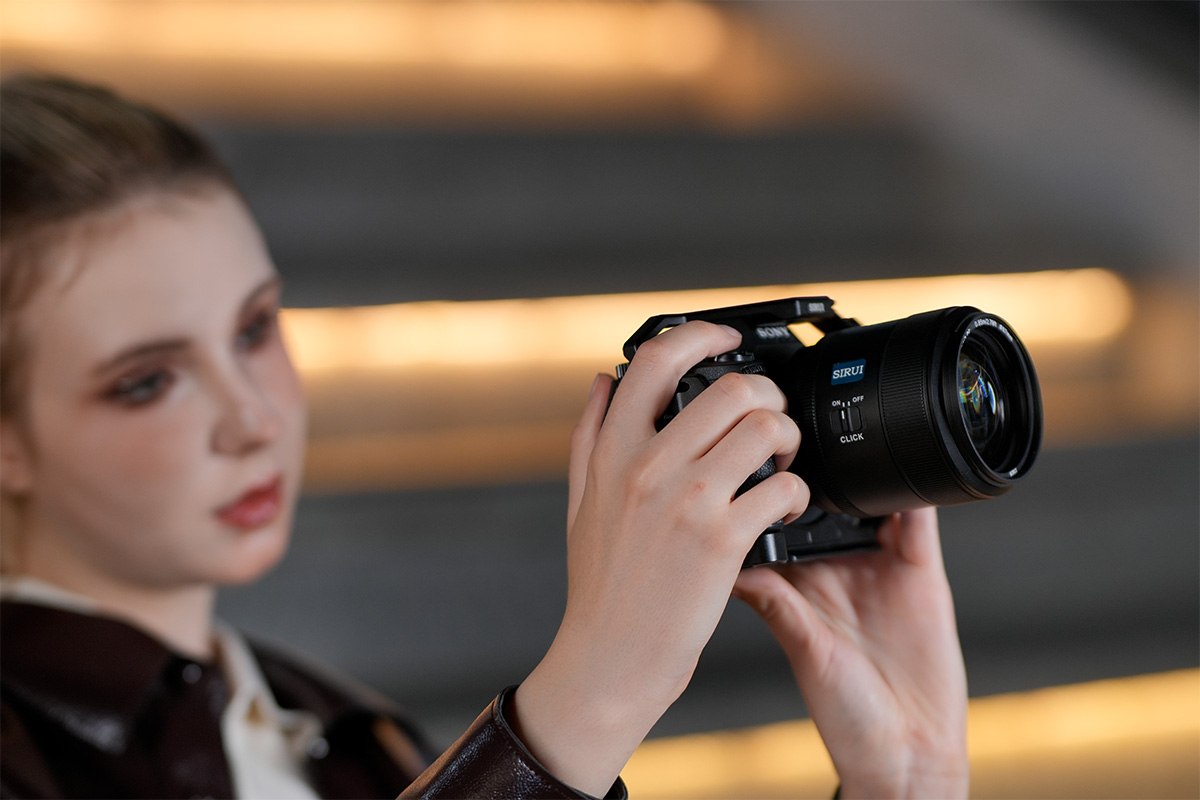
Create timeless black-and-white portraits of women this year with these professional tips on settings and lighting. Also, learn why the latest SIRUI Aurora lens is ideal for such portraits.
Introduction:
Not every moment in life is best captured with black-and-white color correction. In fact, color photography is usually the better choice, as color brilliance and contrasts appeal to us more. So the question arises: why photograph black-and-white portraits of women in black and white at all this year?
The main reason is that such portraits represent the soul of the person in a way that color photography may not allow. The viewer is distracted from distractions and only sees what is important in a subdued or contemplative atmosphere. That is why black-and-white shots, especially black-and-white portraits of women, are widespread today.
To make such shots, you need to use several elements correctly. This helps you achieve the additional emotional depth that is often difficult to capture in full color. The most important are:
Taking Professional Black-and-White Portraits
1. Adjust the Lighting
Since there are no colors here, the light does all the work with overexposed areas and shadows. The right setting is extremely important. For example, start with the direction. Side lighting can emphasize texture and, when used from above, model the face. Placed almost from above, it creates dramatic shadows, and when the main light is used as backlight, artistic silhouettes or edge separations arise.
The direction of the light also influences the depiction of wrinkles, pores, and other facial features in the portrait. Then you need to consider the type of lighting. Common techniques include Rembrandt lighting, which creates a small light triangle under the eye on the shadow side. Other common techniques are strip lighting, butterfly lighting, loop lighting, split lighting, and lighting with diffusers. These black-and-white shots require a lot of time to learn these skills and achieve better results.
2. Camera Settings
Your images lack color, so here you can only influence contrast in terms of optical quality. Make sure your photos highlight and accentuate lines and shapes in the image.
First, set the aperture between f/4 and f/8 if you want to optimally focus on more human features, such as the face and hand of a model. This also works well when photographing multiple women or moving subjects.
Wide apertures between f/1.4 and f/2.8, on the other hand, are suitable for shallow depth of field and emphasizing a specific part of the image. Set the shutter speed to 1/125 – this is sufficient for portraits and faster for moving subjects. Keep the ISO as low as possible if your camera performs well in low light.
3. Camera Equipment for Black and White
The choice of camera body and lenses significantly influences the quality of such portraits. Cameras like the Canon EOS R5 Mark II, Sony α7 IV, and Fujifilm GFX 50S II are excellent options to start with this year. As a lens, we recommend this year the SIRUI AURORA Series 85mm F1.4 Full-Frame Autofocus Lens due to its optical and mechanical advantages.
With a focal length of 85 mm (ideal for black-and-white portraits) and advanced aspherical optics, including ED and HRI glass, this lens delivers stunning portrait quality. Weighing only 540 grams, the lens features a super-fast f/1.4 aperture that renders flattering facial proportions without distortion. It is a great lens this year for high-quality black-and-white portraits.
4. Tips for Composition and Post-Processing
For such shots, the right composition is crucial, otherwise they can end in disaster. Ask the model to maintain intense eye contact, as this can create a strong connection. This can be a direct, sideways, or slight gaze. All are great as long as a visible connection exists. Do not overload the frame with unwanted background elements; use plain fabrics, simple chairs, and architecture.
When editing, crop more tightly to focus on the female model you are photographing. Also, be careful not to overexpose the highlights. In general, the histogram should shift left for low-key shots and right for high-key shots. Always shoot in RAW mode for more flexibility in post-processing.
Summary:
Black-and-white portraits of women require a lot of time to understand composition, lighting techniques, editing skills, and the importance of good camera equipment. The SIRUI Aurora lens was designed to create professional portraits with high contrast and sharpness while producing a pleasant, creamy bokeh.


