

When SIRUI expanded its Vision Prime cine lens series with three new focal lengths—a 15mm, a 75mm, and a 150mm—the update did not look like a dramatic realignment on paper. But for a tester who tried the new lenses alongside the original 24mm, 35mm, and 50mm kit, it was ultimately the 15mm that made the strongest impression—and for reasons he had not expected.
The Vision Prime series expands
The original Vision Prime Kit —24mm, 35mm, and 50mm—launched as an entry-level set for filmmakers at around €1.779,00 , built around one key feature: an interchangeable mount system. The lenses ship from the factory with a Sony E-mount, but can be converted to Nikon Z, Canon RF, or Leica L—so switching cameras does not mean having to start the lens collection from scratch.
With the 15mm (€739), 75mm (€739), and 150mm (€739)—also available as a three-lens set for €2,159—the series now comprises six focal lengths, ranging from ultra-wide-angle to long telephoto. For those who already own the original three, the new set does not change the system's look; it simply fills the gaps in the focal-length range. The tester received the 15mm and 75mm for review—chosen deliberately because they fill the two gaps most lacking in a working kit: a super-wide-angle option and a somewhat longer, more compressed focal length for tighter framing.
Hands-on test with the 15mm T1.6
The 15mm is a T1.6 lens with a minimum focusing distance of approximately 0.3 meters and a 77mm front filter thread. In practice, this combination opened up two very different shooting situations during the test.
Outdoors, the lens was used for a low-angle wide shot of a pickup truck in an open meadow, captured with a Nikon camera. Even with the sky and horizon occupying most of the frame and the sun low in the sky, the lines in the image remained straight—there was no pronounced barrel distortion at the edges—and the sun flares were present but restrained rather than overwhelming.
At the other end of the distance scale, the tester also used the 15mm at its closest focusing distance—0.3 meters—to capture a small table figurine beside a color calibration chart. At this distance and with the aperture wide open at T1.6, the background blurred softly while the subject remained sharp—an appearance you might not necessarily expect from such a wide lens.
Distortion and Focus Breathing at 15mm
Ultra-wide-angle lenses often involve compromises—strong distortion toward the edges or noticeable focus breathing when focusing. The 15mm’s performance in both areas was described as one of the test’s bigger surprises. Distortion was minimal and barely perceptible, while focus breathing was also well controlled—visible only on close inspection and largely unobtrusive in normal shooting.
This combination makes the 15mm well suited to interior shots, staged room scenes, and any situation in which the surroundings are just as important as the subject itself. The relatively short focusing distance also allows for a tight composition while keeping the environment around the subject visible.

*Photo by Will Hall
Wide-Angle vs. Telephoto: Where the 15mm Fits In
In combination with the rest of the Vision Prime series, the role of the 15mm becomes clearer. The 24mm, 35mm, and 50mm focal lengths cover everyday situations, while the 75mm provides compression for portraits and detail shots, and the 150mm extends the range for more specialized shots. The 15mm sits at the wide end of this range—the lens you reach for when a scene calls for an establishing shot, an entire room, or a vast environment rather than a tightly isolated subject.
Overall, the image quality of the two new lenses matched what the original Vision Prime set already delivered: clear, sharp, and more clinical than characterful. Chromatic aberration can still appear in high-contrast, out-of-focus areas at wide apertures, and lens flares remain subtle rather than dramatic—in other words, these lenses are not designed for pronounced vintage character, but for controlled, modern cinematic images.
Build Quality and Everyday Handling
Throughout the series, the 15mm and 75mm share the same solid metal construction as the original three lenses, available in metal gray or black. The focus and aperture rings are grippy, move smoothly, and—remarkably—are positioned identically across all focal lengths, so a follow-focus or aperture rig set up for one lens does not need to be readjusted when switching to another focal length. Only the distance to the front element varies, which can matter with rod-mounted accessories such as a matte box.
FAQ
What aperture does the SIRUI Vision Prime 15mm have?
The 15mm is a T1.6 lens, making it the fastest wide-angle option in the Vision Prime lineup.
Does the 15mm suffer from distortion at this focal length?
In testing, distortion was minimal even at 15mm, and straight lines remained well preserved right to the edges of the frame.
Can the Vision Prime 15mm be used with different camera systems?
Yes. Like the entire Vision Prime series, it features a changeable mount system and comes with a Sony E-mount, with conversion options for Nikon Z, Canon RF, and Leica L.
What is the minimum focusing distance of the 15mm?
Approximately 0.3 meters—allowing for a tight subject composition while keeping the surroundings visible.
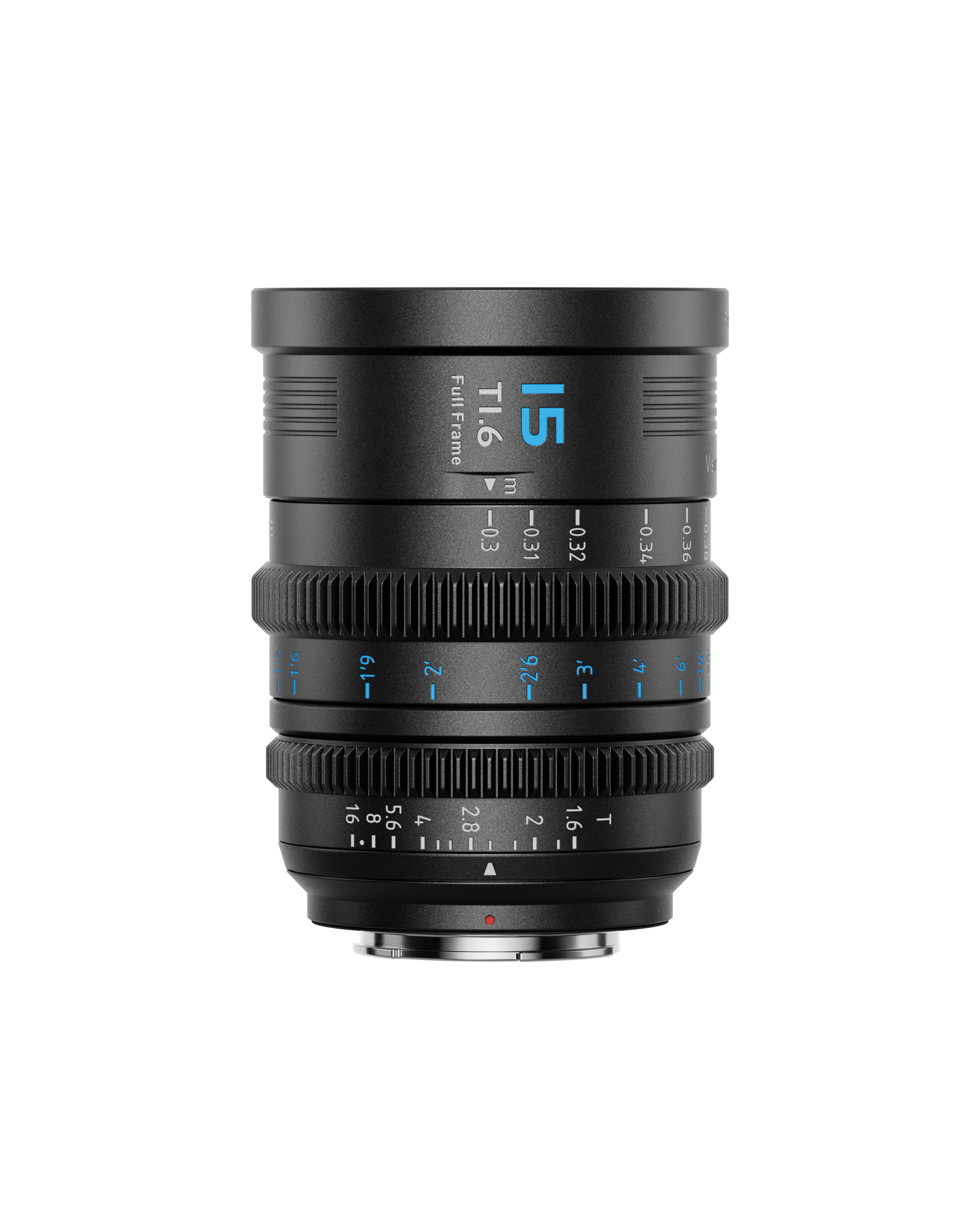
SIRUI Vision Prime 15/75/150 mm T1.4 Full-Frame Cine Lens
Full-frame cine lens set for ultra-wide-angle, portrait, and macro shooting, featuring a user-changeable L/RF/Z mount system for quickly switching between camera bodies.
Buy Now
Authentic review based on: https://www.youtube.com/watch?v=x6ukg-JVZWw


