
With the impressive lens ecosystem, lenses for the Canon EF mount are considered legends among DSLR cameras. Whether you're a beginner or a pro, EF lenses impress with excellent variety and reliability. Need the perfect lens for your Canon camera? Check out this article. You'll definitely find your match here!
With excellent color reproduction and user-friendly operation, Canon DSLRs are the first choice for many. Are you currently selecting suitable lenses for the Canon EF mount? This article introduces the features and types of these lenses and offers some advice.
1. Lenses for Canon EF Mount: An Iconic Innovation
In 1987, the EF lens appeared out of nowhere and revolutionized the photography world by eliminating mechanical switches. Everything runs electronically faster, more precisely, and more reliably.
With excellent compatibility, EF mount lenses can work with both full-frame and APS-C cameras. However, the crop factor must be considered to flexibly adjust the focal length. Additionally, the EF lens features a large diameter with an inner diameter of 54 mm, providing a good basis for a large aperture.
2. EF Lenses: Which Lens Does What
Lenses for the Sony E mount can be categorized by focal length and use cases into zoom lenses, standard lenses, wide-angle lenses, and telephoto lenses.
With a wide field of view, wide-angle lenses are suitable for landscape and architectural photography. To avoid distortion at the edges of the image in this case, aspherical lenses can be used.
Zoom lenses with variable focal lengths are considered the first choice by many because they are suitable for diverse scenarios, allowing you to adjust the focal length as needed.
Telephoto lenses usually have a focal length over 70 mm. With fast autofocus tracking, telephoto lenses are indispensable for sports and wildlife photography. Due to their long focal length, super-telephoto lenses are the professional choice for extreme distances and are often used at sports events and in nature photography.
3. Practical Tips for Choosing EF Mount Lenses
First of all, choose the lens type based on your shooting needs. For example, prime lenses with large apertures are recommended for portrait photography to achieve shallow depth of field and high image quality. Wide-angle lenses are recommended for landscape photography.
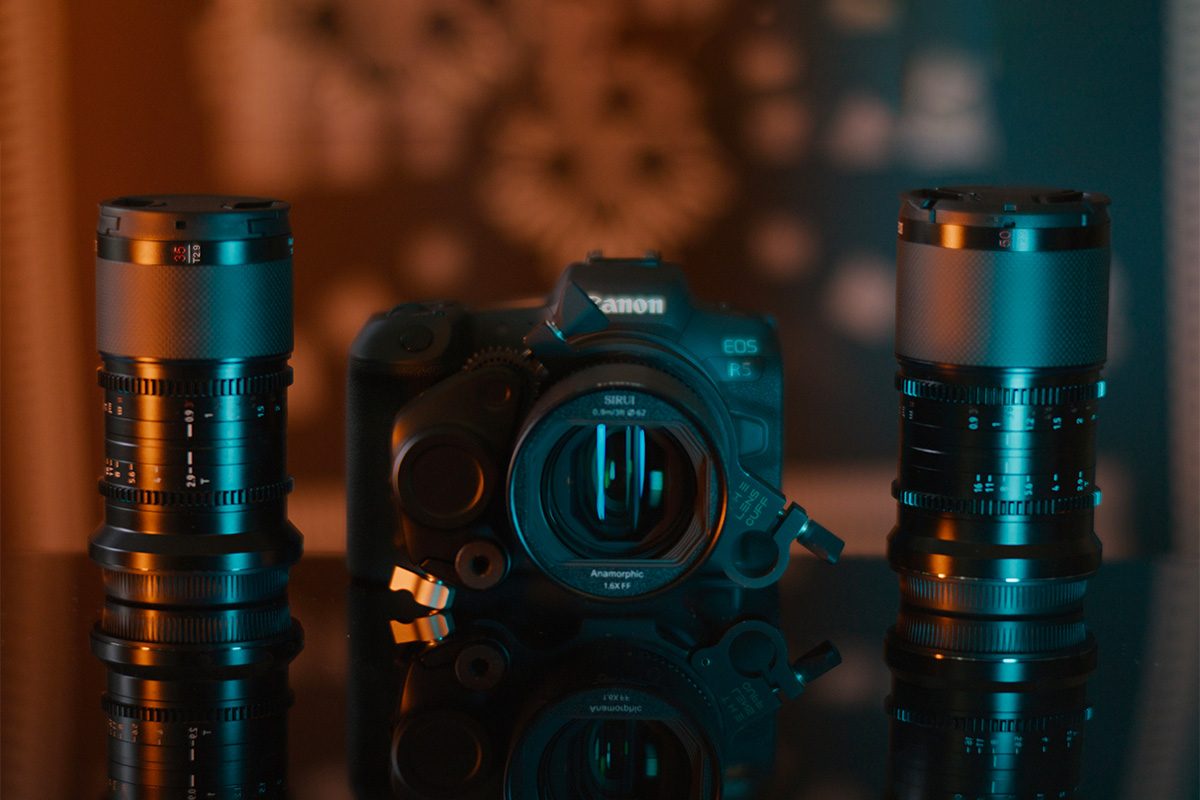
SIRUI Saturn 35/50/75mm T2.9 1.6x anamorphic carbon full format lens is a great choice for landscape photography, featuring aspherical lenses. Unlike normal spherical lenses, they can correct spherical aberrations. This means that optical designers can achieve aberration correction with fewer elements compared to conventional spherical lenses. As a result, distortion at the edges of the image can be avoided, achieving better optical results.
You should also balance performance and budget well. It is important to set priorities within your budget: focus on optical quality and robust construction. Avoid blindly chasing expensive high-end models. In this case, buying second-hand is also a good idea.
Furthermore, you need to consider image stabilization and autofocus technology. Telephoto lenses like the 70-200mm F2.8 definitely require an IS image stabilizer to prevent shake. For videography or fast tracking, lenses with USM ultrasonic motors are recommended, as they focus quietly and precisely.
Fourth, pay attention to lightweight design. For travel or street photography, compact lenses or models with composite housings are recommended to reduce weight and increase mobility.
Future compatibility should also be ensured. If you might switch to mirrorless full-frame cameras, full-frame EF lenses (not EF-S models for APS-C) are recommended, as they remain compatible via official adapters. Also, check whether newer RF lenses are backward compatible with EF cameras.
With this strategy, you can choose lenses that meet both your current needs and future system expansions.
Conclusion:
Whether you are a beginner starting with a 50mm F1.8 or a pro with a 400mm F2.8 for sports events, lenses for the Canon EF mount remain unbeatable in flexibility. If you want to find your dream lens, first check your shooting scenarios—are you a portrait lover or a wildlife fan? Second-hand is also a good choice, where you might pay about 30% less. And never forget to check whether the lens is for APS-C cameras or full-frame!


