

In February 2026, Sigma announced the development of the 85mm F1.2 DG | Art, completing its trio of F1.2 Art primes alongside the 35mm and 50mm F1.2. The announcement brings a familiar question back to the table for portrait photographers: Does one extra stop of light and a shallower plane of focus actually make an F1.2 lens noticeably better than a well-built F1.4, or is the practical difference smaller than advertising suggests? The SIRUI Aurora 85mm F1.4 provides a useful point of comparison, as it already offers the key benefits of a fast 85mm prime for €529—a fraction of the investment usually required.
Why is 85mm a classic portrait focal length?
The 85mm focal length is preferred for portraits because it renders facial proportions naturally and compresses the background from a comfortable shooting distance. This avoids the exaggerated perspective of wide-angle lenses while allowing the photographer to remain close enough to the subject to direct them effortlessly.
This moderate working distance is also practical on set. It leaves enough room for lighting equipment and reflectors without requiring instructions to be shouted across the room, and works equally well for headshots, half-body portraits, and environmental shots where the subject remains clearly in focus. This is one reason why 85mm prime lenses remain a staple of wedding, event, and commercial portrait photography, regardless of their maximum aperture. For anyone still unsure about choosing the right focal length for portraits, 85mm is usually the most reliable starting point.
What does F1.2 really offer?
F1.2 provides about 2/3 of a stop more light than F1.4 and slightly shallower depth of field—not a dramatic leap in background blur. The more noticeable benefits appear in shutter speed in low light and in how smoothly the background falls out of focus.
At typical portrait distances, the difference in background separation between F1.2 and F1.4 is more subtle than fundamental, since depth of field also depends heavily on the distance to the subject and background. Where F1.2 really helps is in dark locations, where the additional light allows for a faster shutter speed or lower ISO, as well as providing a slightly smoother transition at the edges of the subject. For photographers who already regularly work with F1.4 prime lenses, the move to F1.2 is more of a refinement than a reinvention of what the lens can do.
How does the Sigma 85mm F1.2 compare with the SIRUI Aurora 85mm F1.4?
The Sigma 85mm F1.2 DG | The Art is aimed at photographers who want the widest possible aperture at 85mm and are willing to pay a professional-level price for it. At €529, the SIRUI Aurora 85mm F1.4 covers most of the same use cases—with a lighter, more travel-friendly design and a fraction of the cost.
At the time of this article, the Sigma 85mm F1.2 is only a development announcement: Sigma has confirmed a Dual HLA autofocus system and a planned market launch in September 2026 for L-Mount and Sony E-Mount, but weight, dimensions, and price have not yet been released. The table below compares what is already known about both lenses.
| Feature | Sigma 85mm F1.2 DG/Art | SIRUI Aurora 85mm F1.4 |
| Focal length | 85mm | 85mm |
| Maximum aperture | F1.2 | F1.4 |
| Sensor coverage | Full-frame | Full-frame |
| Mounts | L-Mount, Sony E | Sony E, Nikon Z, L-Mount, Fujifilm X |
| Autofocus | Dual HLA (High-response Linear Actuator) | Stepper motor AF with Eye AF and subject tracking |
| Filter thread | 82mm | 67mm |
| Weight | Not yet known | 540 g (E-Mount) |
| Availability | Development announcement; planned market launch September 2026 | Currently available |
| Price | Not yet known | 529 € |
Sigma’s Dual HLA system and larger 82mm front element suggest a lens designed for maximum optical performance at F1.2—for photographers who prioritize uncompromising sharpness and background separation over size and price. The Aurora 85mm F1.4, on the other hand, keeps the weight to 540 g and combines a 67mm filter thread with Eye AF and subject tracking, making it easier to carry throughout a full day of shooting or pair with a gimbal for video work.
Is the extra stop of F1.2 worth the higher price?
For most portrait photographers, F1.4 already delivers strong subject separation, reliable low-light performance, and natural rendering of facial features—covering the majority of everyday portrait work. F1.2 is mainly worthwhile for photographers who need the absolute shallowest depth of field or work professionally in very dark conditions.
Weight and price are the other half of the equation. A lighter, more affordable F1.4 lens like the €529 Aurora is easier to justify for photographers who shoot portraits alongside other genres or are just building their first fast prime lens. SIRUI also applies its experience with autofocus-capable, fast lenses elsewhere in its range: The Sniper series offers F1.2 autofocus prime lenses across five APS-C focal lengths (16mm, 23mm, 33mm, 56mm, and 75mm)—but for a different sensor format and a different purpose than a full-frame 85mm portrait lens. For full-frame portrait work, the practical question is not which lens has the larger aperture on paper, but whether those additional 2/3 stops change enough images to justify the extra weight and higher cost.

Frequently Asked Questions
Can an F1.4 lens achieve bokeh similar to an F1.2 lens? At typical portrait distances, largely yes. The optical difference in background blur between F1.2 and F1.4 is subtle, as subject and background distance affect the bokeh more than the 2/3-stop difference.
Is the SIRUI Aurora 85mm F1.4 suitable for professional portrait work? Yes. It offers a fast F1.4 aperture, Eye AF with subject tracking, and a lightweight 540g design, making it suitable for portrait, wedding, and event photography.
Is SIRUI making an F1.2 lens? Yes, but not for full-frame. The SIRUI Sniper series offers F1.2 autofocus prime lenses for APS-C cameras across five focal lengths (16mm, 23mm, 33mm, 56mm, 75mm).
Can I buy the Sigma 85mm F1.2 and the SIRUI Aurora 85mm F1.4 now? The SIRUI Aurora 85mm F1.4 is currently available for €529 for Sony E, Nikon Z, L-Mount, and Fujifilm X. The Sigma 85mm F1.2 is not yet on sale; it remains a development announcement with a planned market launch in September 2026.
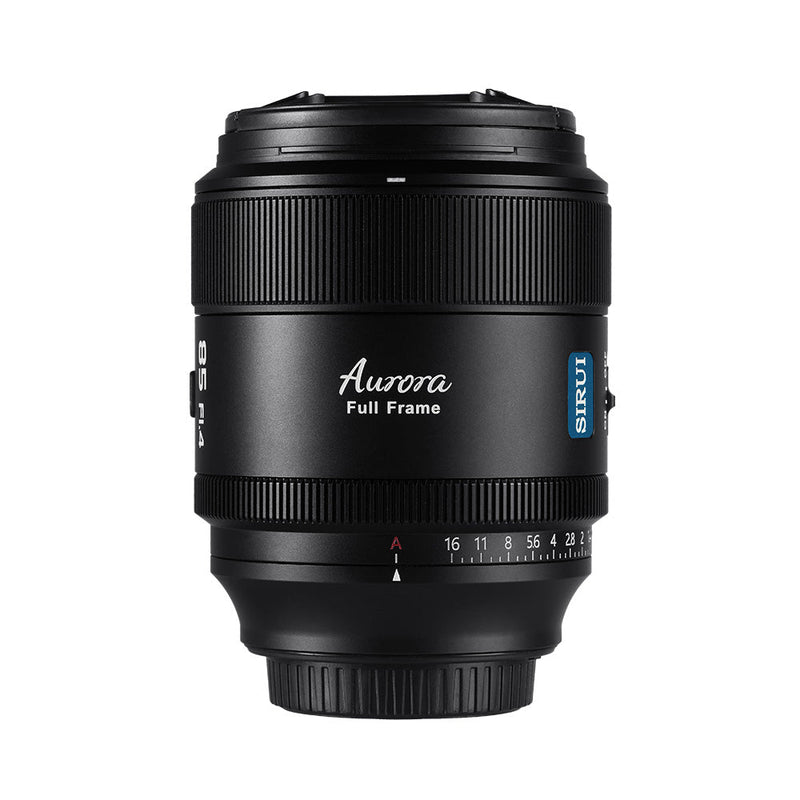
SIRUI AURORA Series 85mm F1.4 Full-Frame Autofocus Lens
- Full-frame | f/1.4 to f/16
- Fast portrait prime lens
- AFL button, AF/MF switch, ON/OFF button
- Aspherical, ED, and HRI elements
- 15-blade aperture


